MTV, my big bang
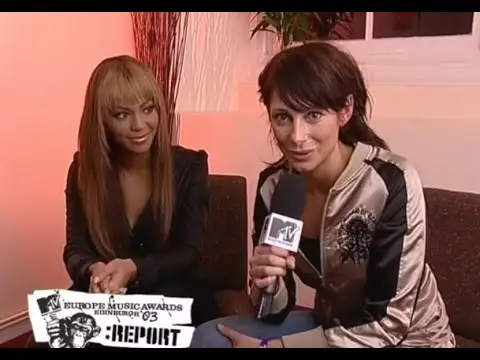
From Lowlands to MTV VJ in the Netherlands. Barbara Karel talks about her MTV adventure, a screen test, and her first interview with David Guetta.
You want to become a Voice Over; here is how you do it.
It’s a dream job. Being your own boss, setting your own hours, working from home, being creative, talking a lot. That sounds good. And yes, it is.
Anyone can handle a computer and anyone can buy a microphone. It can’t be that complicated, can it? And yes, it’s an insanely cool, varied profession and if you do it well you can make a nice living at it.
So I regularly get the question “How do I actually become a Voice Over?
But alas, I don’t host people at my studio and no, I won’t have a cup of coffee with you either. Not even a call, sorry. Not because I wouldn’t want to in terms of friendliness, but simply because I don’t have time for that.
My beautiful family, my dear friends, family, and my business deserve all my attention, and with that, my time is up. In fact, I have too little time. What I can do is tell you right here how to become a professional voice actor. This is based solely on my own experience, of course—there are many roads that lead to Rome.
A voice actor has a pleasant voice to listen to, but if you want to become a professional Voice Over, you also need to have a talent for script interpretation. In other words, feeling the text. Just because you have a nice voice doesn’t mean you can tell a story in an engaging, effective, and believable way. It’s tough, but that’s the reality. That’s why script interpretation is just as important as a pleasant voice.
If you lack any of these skills, then you can shake it.
Then, of course, there are various disciplines within the voice-over profession. So you can voice audiobooks, cartoons, commercials or serve the corporate market. There are numerous directions you can go. First, think about where you’d like to start and just give it a try. Pull a practice script from the Internet or grab a newspaper, sit down in front of it with your phone and record yourself. So read aloud, doesn’t really matter what kind of text. Try at your very best to tell the text the way you think it should sound when you are Voice Over or voice actor later. Listen back to that recording.
Well what do you think? Does it sound a little “tasty” and “believable and natural”?
And yes, of course, you still have everything to learn in the beginning. But telling a story (short or long) in a ‘believable and natural’ way is something you need to have an intuitive feel for. Empathy AKA script interpretation. Natural talent helps enormously, but you can also further develop your interpretation skills with a lot of practice. It’s that simple. Just like I could never be an accountant. Me and numbers? A total nightmare.
Tip, and you really should do this one: Let other people hear your audio file!
Be sure to ask them to be honest and critical, because friends will always tell you it sounds great, even if it’s total rubbish…. Do you believe your own story? And do others believe it too? Are you still convinced that you want to and can become a voice-over artist?
If your friends say you should really do something with your voice, then you start practicing—a lot. This means printing out even more different types of scripts and really sitting down for it. Not once, but a thousand times. Record yourself and listen back until you drop. And above all, be critical of yourself. Improve and get good. You can’t enter the market without already being somewhat skilled and experienced, because you simply won’t get booked. The Voice Over world is a fast-paced market; clients don’t have time to coach newcomers. If you really want to become a Voice Over, you have to nail it immediately. If you start off poorly, they certainly won’t book you again in the future.
Once you have practiced extensively, you could potentially take a workshop for beginning voice-overs.
For the people in the Netherlands: With Ruby, a very professional Voice Over and delightful woman who offers customized training. You can also sign up at voiceovercollege.nl or voice-acting.nl, where you will find awesome and professional workshops.
It may seem like a big investment, but besides being fun to do, it also reveals whether you have real talent. Maybe it won’t end up in what you want to hear, but then again, you know that, right?
A workshop like that is good because you’re there with several students at the same level, and you can compare yourself unabashedly. Am I really that good or that bad? And how do others do it? It’s inspiring and educational. In the voice-over profession, it’s all about experience and putting in the hours. So the more you record, the better. At some workshops, you even get a demo of your recorded work to take home afterward.
By the way, I did not do a voicing workshop, but had the necessary experience from my MTV time, my radio show at 3FM and as stationvoice of NPO3. So my first practice meters I had already turned fairly well.
Note! Don’t think that you can immediately start working as a professional Voice Over and the jobs are pouring in.
You might have expected that doing a course would have you mastering all the intricacies of the trade in no time. And that you would be handed on a silver platter how to build a good studio (for next to nothing) and what microphone you need. Hup, get to work the next day right? But unfortunately, that’s not how it works. Let me explain.
Again, as a Voice Over or voice actor, it is important to practice and keep practicing your ass off.
Reviewing commercials, recording and listening back to scripts, varying voice tone, intonation, loud, soft, doing typing. Getting comfortable with your own voice as well as hearing what you are doing. I too, after years of experience and endless different types of assignments, still practice, listen and learn. Your voice is an ingenious instrument. If you want to become a Voice Over with your own studio and seriously serve the market, you need to know your voice inside out and play it perfectly. Just like singers and vocalists.
If you want to become a Voice Over with your own studio, you must practice not only with your voice, but also with your ears!
It is crucial that you develop your hearing so that you hear what you are doing. And, of course, that’s not just in flawless voicing. The smallest nuances in the use of your voice (read: intonation, tempo, power and flow) make the biggest difference.
The best way to develop that is by putting in even more hours. So in the beginning of my homestudio adventure, I spent night after night into the wee hours learning how to use and play those instruments.
Compare it to playing the piano, or any other instrument. You will have to practice your butt off to get good at it and get a blind feel for it, because generally you work all by yourself.
So, go for it. Practicing is the most important step. If you’re not willing to practice hard, it will be difficult to become truly good at this.
You’re a star; you’ve practiced, listened back, and pushed yourself to the limit with tears in your eyes. You want to become a full-time Voice Over, you’ve really found a great flow, and you’re ready to head out into the wide world. Hooray! But what now? Are you going to make a decent demo first (3A) or are you going to build a studio right away (3B)?
I would go for 3A. First, a good professional demo. If you don’t have one yet, it’s smart to do it with someone who knows their stuff—a well-known studio you might have worked for once, for example.
Should you feel you can do it yourself, go for it. I made my first demo at a studio for which I had already voiced a few assignments. He did want to help me make a full demo. Since I did not have my own studio at that time, I was able to record some additional material with him. We mixed that with the assignments I had already done. That’s how I got a good professional first demo.
Okay, for me it went like this: because I did voice-over work on location during my time at 3FM and MTV, I was already somewhat known in the scene. I was also the station voice for NPO3. Since I was at home with two small children, I built my home studio right away because I couldn’t just leave the house. It was certainly a gamble, as I didn’t have much work yet. But because I didn’t know what else I could do, it was the best choice at the time.
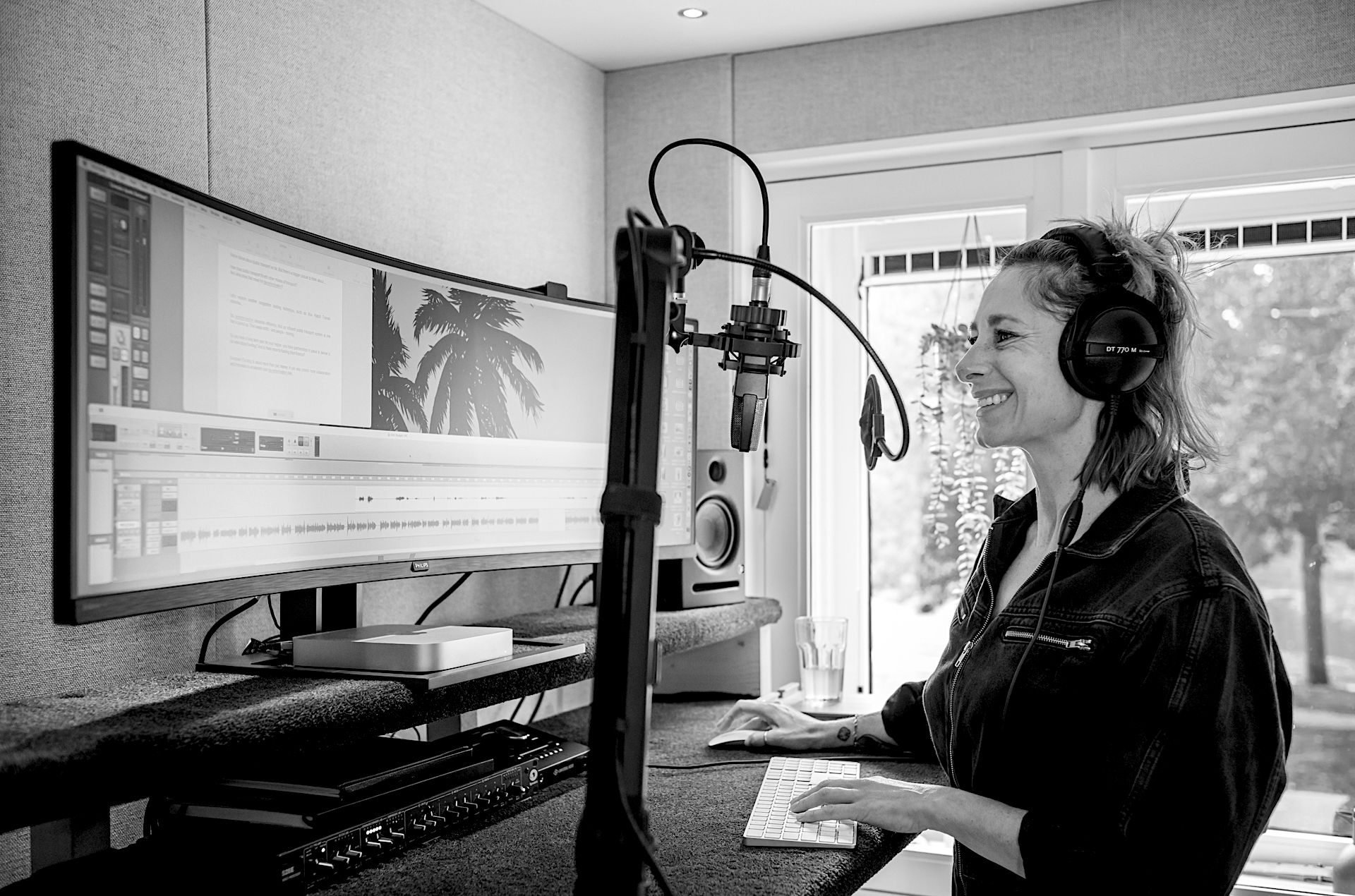
The quietest room in the house became the place where it had to happen. Together with a friend, I built a vocal booth there. . You can make it as crazy as you want, of course. You can have a studio built if you have budget, but I didn’t have a big budget so built it myself. A double-walled cabin of about 130x130x230 made of Gamma MDF boards and glass wool. Then I installed Auralex foam on the inside, put good flooring on the floor and made a nice double-walled door. It was still a big job, but it worked.
Just a little side note: building a cab yourself is tricky though, because if you’re unlucky it won’t sound like anything.
Becoming a voice over is not easy. You have to produce good sound on all fronts. And so think carefully about your material, construction and where you put it. Sound is a special phenomenon. The soundproofing of your cubicle is half the trick, the acoustics you create the rest of the recipe. I was lucky, my homebrew vocal booth had a nice dry sound right away. Little to no noise or weird side noises and no indeterminate reverberations. Then I had a topnotch audio engineer flown in to have the acoustics optimized. He said I was fine with that booth of mine. Nice, because for about €1000 (2011) I was another step ahead.
This is tricky because each Voice Over or voice actor has his/her own preferences in terms of MiC, pre-amp, interface and audio program. Some like this to work, others like that. Since I really had no idea what would work for me, I bought practically the same set that a helping colleague in the profession also worked with. I ordered everything from thomann.de, but you can also do well at Baxshop.
My first microphone was a Neumann TLM 102. A great entry-level model for my studio at the time. Fairly affordable and easy to resell if it didn’t work out. The mic worked well for that moment; I could get things done with it. Lucky again. I have a new mic now because I was ready for the next level, but that Neumann was a perfect start.
Then I also have the Symetrix 528E voice processor. Then no idea what to do with it, but I had it beautifully. As we speak, it is still here and, of course, I do know exactly how it works. I figured that out with the help of internet tutorials.
Curious about what my studio looks like now? Check out my current professional voice-over studio.
Furthermore, I work with Apple, a Universal Apollo Twin interface, a JZ pop filter, and of course, top-quality cabling. Don’t buy cheap junk, because then you can get crackles, clicks, and noise. And I immediately bought the latest Pro Tools. All in all, I think the home studio back then (2011) was an investment of €5,000.
But whaaaaaaat the f*ck is all this now? I didn’t understand a thing. Suddenly you’re sitting there with your studio that you actually have no idea how it works….
First, I searched the Internet for “Protools and audio engineering classes. Nothing to be found, of course. Yes well by the way, in Amsterdam I found some kind of workshop for audio technician, but it was too extensive and too expensive for me. My money had run out.
There was nothing else for it but to teach myself the technical side. So every spare hour I had (which I didn’t really have with 2 small children), I spent installing, tinkering, and watching YouTube tutorials. It became a battlefield. It was so incredibly complicated. I thought I would never learn it. Tears, swearing, and angry moments where I thought:
“Fuck that Voice Over being, I’m selling the place again!”
Fortunately, I had a friend who helped me out in case of emergency, and that’s how things worked out after all. Although it did take some time before I could do anything at all with my studio and nothing kept messing everything up. By now I am a Handy Harry with my studio gear.
If you want to have your own professional audio studio, you need to be really driven or have someone to assist you (online) if needed. If you’re not ready to build a studio just yet after reading this, make sure you can record at a good studio in your area. Who knows, you might just have a job coming in and need to be able to move quickly. Yess, demo and studio are done, on to step 4!
And now the ‘behind-the-scenes work’ begins. That too can be a big job, unless you hire (paid) help. If you want to become a Voice Over and earn your living with it, you really need a cool website and a network. Because yes, people need to be able to hear that demo somewhere, of course. Additionally, it’s nice if people can read something about you, what you stand for, and what you can do.
I built my first website myself. Fortunately, I was reasonably handy at it, and the competition wasn’t as cutthroat as it is now. The site (a one-pager) did what it was supposed to do. It was clear, fresh, looked pretty good, and I was fairly easy to find. Nowadays, it’s a bit more complicated. The competition is huge.
So think carefully about the structure of your site, texts, images, blog, references, social media, SEO, etc. Your site must be good and professional on the front end and the back end, otherwise, no one will find you online. An SEO check can be useful. A targeted Google Ads campaign can also help. Immerse yourself in that so you know what it’s about.
You can also choose not to build a site and put everything on a channel like TikTok, YouTube, SoundCloud, or Vimeo. I just don’t think that’s enough. After all, you’re not the only one. So make sure you are easy to find in multiple places! How you present yourself online is, of course, something you have to decide for yourself, but believe me, nowadays your site and social media are your business card, so it better be good!
“Very cool that demo, studio and site, but I want action now actually, I want to become and be Voice Over! Bring on those assignments!”
I completely understand that. That’s why here are some handy tips to get your foot in the door. Although, of course, they offer no guarantee of success.
What you can do is the following: go to google and you search for: web video, advertising agency, audio production, voice-over, all the keywords you can hang a voice-over on. Create a list of email addresses of people and companies who work with Voice Overs.
Have you collected at least 50 interesting contacts? Then you can start emailing. Just do some very old-school prospecting. It takes a lot of time, but that’s how I did it. And I also approached everyone with a personal touch—so no bulk mail, but just a sincere personal header and a good story with your demo attached. ‘Hmmmm, no responses… well, a few. Crap, what’s going wrong?’
And when I received it, I was very happy, but also blood nervous. All of a sudden I had to do it for real in that studio by myself. It was only a small job, but still. Suddenly I began to doubt myself enormously. I plowed myself through it and sent the audio a day later…silence. I didn’t get anything back. I had to wait two days until I received the redeeming email that they were very happy with my work.
Woopwoop! I could do it!
I had succeeded. Between the time the first screw went into that vocal booth and the first official home assignment were about 8 months of misery. I had run out of money and had yet to learn all the techniques, but apparently I had the basics down and that was good news. It gave me renewed courage and I continued to practice and network.
You can also email voice agencies directly. If you Google them, you’ll find plenty, such as Voicebooking, Voices Industries, and Post Office Voice casting. Pick a few that you think suit you and send your demo; just see what happens. Pay close attention before you pay any registration fees anywhere. First, research whether the platform is reliable and whether the costs outweigh the potential assignments. If they want you on board and think they can do business with you, they really won’t ask for a registration fee.
With me, things went differently. In fact, I received an email from Voicebooking itself. Whether I wanted to join their club. That caught me by surprise, because I hadn’t seen that one coming at all I had just started, but of course I wanted to. I could not have wished for a finer confirmation of my talent.
The ball really started rolling. The first assignments came in and the first year as a Voice Over with its own studio I was turning over almost minimum wage for a 19-year-old. ‘
Once the momentum took hold, I always continued to invest and develop. That’s really MEGA important. Don’t think that once you’re in between and your assignments flow nicely, that it will stay that way. Competition is cutthroat even if you already have work.
For example, a year after I created my own website, I had one made, a comprehensive and really professional one. And yes that cost another bucket of money. Incidentally, though again to its own design, but technically a lot more sound. Two years later, I had that site upgraded again.
Recently I launched a new version of my website. Conceived and built entirely by myself, with many hours of practice and watching tutorials. . Conceived and created entirely by myself with more hours of practice and watching tutorials. And great technical support from Layla from jouwimpactonline. The internet is constantly developing. If you want to stay in the game, your website must stay up to date.
In addition, of course, I keep a close eye on vocing trends by regularly watching an evening TVcommercials instead of Netflix and parroting.
In addition, I use the rest of my time (when I’m not recording) to work on my business—entrepreneurship, basically. I exercise a lot and regularly skip parties to keep my voice in top condition. Now, many years after the kick-off, I can say it definitively: I made it!
For example, I speak in daily and have many repeat clients. AND, most importantly, I am always there for my children, because that’s what I was all about. But it was a lonely rollercoaster ride. Filled with frustration, tears, half a burnout, an empty bank account, but also a good dose of endurance, the necessary help and a few fluke.
I now work from my own high-end voice-over studio. Completely custom-made to my wishes, fully soundproofed, and acoustically perfect down to the last detail. Box-in-Box, as it’s called—a room within a room. Double doors, windows, and a floating floor so it makes no contact with the house. Built by professional high-end studio builders. Yes, it cost serious money, but I had earned it. I worked my tail off for 10 years to achieve that.
So, this is my whole story.
But gas up that lollipop and it can be done! I hope this is of some use to you. That I was able to make it clear to you that it was a tough job and at the same time the best work adventure I have done. You just have to really invest in it. In terms of both time and money.
Bon, I’m glad I went for it this way and never want anything else. #lovevoiceover, maybe I should get that tattooed on my arm.
Cheers and good luck ya’ll!
Barbara
And do you want to see what goes on in my studio? Check out my studio vlogs here.
Share this post:
From Lowlands to MTV VJ in the Netherlands. Barbara Karel talks about her MTV adventure, a screen test, and her first interview with David Guetta.

Writing voice-over scripts? Discover how to make your message sound more powerful with modern Dutch, natural spoken language, and short sentences.

Why do so many brands choose a female voice-over? A female voice provides warmth, trust, and a natural sound.